Tuesday, May 17, 2011

Done!

The decks are done. We went back in the water on Saturday, May 7th. Took the boat back to Marina Palmira and started the drudgery of moving out of the rental and getting the boat put back together. We got out of the rental by the 12th, but the putting back together process is still underway to some extent - not only had just about every single thing aboard been moved to the middle of the boat so that the guys could access the underside of the decks, but all the stuff that had migrated over to the casita had to be reabsorbed. I'd say we're at about 90% at this point.

We've decided to stay in La Paz for the summer - the more we talked to people about Mazatlan, the hotter and steamier it sounded. We'll go to the mainland after hurricane season. Art's going to fly up to San Francisco and retrieve our car this weekend - Marina Palmira is definitely nicer than Marina de La Paz, but it's a way out of town, so the car, while not absolutely necessary, will be very nice to have. Hopefully, when Art gets back, we'll have a chance to get up into the islands before the really hot weather gets here. Redoing the decks sort of ate our cruising season this year, but the project was well worth it.

Decks:


We are extremely happy with how they came out.

Monday, April 11, 2011

Decks, Cont'd

The decks are coming along.


They're only able to glue down two planks at a time on each side, so it's rather slow going, but they're looking really nice, don't you think?

Once everything gets glued down, the job should speed up again - caulk, sand and reinstall fittings (we're hoping to do that last one in the water, rather than on the hard - cooler, and no ladders involved, which would mean I could help).

Meanwhile, I'm in LA for the week, taking care of some states based business, including our taxes. Leave it to me to manage to schedule a trip north during a cold snap - it's supposed to be in the 40's tonight. Brrrr. I have definitely become acclimatized to Mexico.

Wednesday, March 30, 2011

Off with the old

We're about two and a half weeks into the project, and the old teak is all off the deck. It was quite an involved process. Art's been helping with the work, both to see how it's done and to keep the cost down. He's also been taking some pictures. Apologies in advance for the scarcity (and size) of said pictures - when we're on an internet connection where we're not paying by the mb, I'll post more.

First, all the hardware had to come off. There is a lot of stuff on the deck of a Mason 44. Chainplate covers, stanchions, deck fills, hose bibs, blocks, track, etc. All this is through bolted, so the first step was to empty out the lockers and take down all of the headliners under the deck down below. Then everything has to be removed, numbered, bagged and stored. The result is a boat that looks like this:


While that was happening, Reggie and his helper were going over the deck, removing the thousands of screws that attached it to the fiberglass substrate. Some people don't remove the screws, but instead just cut them off. This is a bad idea - it leaves thousands of tiny holes in your deck, and, if you're doing paint or fiberglass rather than teak, the screws can print through the new surface over time. We've seen boats where this has happened, and it's not pretty. Some people will just pry the screws up when they remove the teak. Also a bad idea - you can actually delaminate the upper layer of fiberglass decking from the balsa core, and that's a very expensive and difficult thing to fix.

Then the teak has to be pulled chipped chiseled off the deck. Masons are very well built boats. Correspondingly, even after 22 years, the teak was extremely firmly attached to the deck. Art said the average size of the pieces they were able to remove was ~2" long. It was pretty tough going. Eventually, they got all of the teak up, and were left with a bare fiberglass deck with bits of mastic adhering to it. That all had to be scraped/ground off. Messy.


Interestingly, we did not have fiberglass non skid under the teak. I'd heard that a lot of these boats did, as the non skid pattern was in the molds used to build the boat. On our boat, Ta Shing apparently ground it down before installing the teak. That's probably part of why the teak was so well stuck.

Once they got all of the mastic scraped/ground off of the fiberglass, it was time for one last grinding to smooth everything down, and they were ready to lay the new teak.

Oh, but what's that? This isn't teak caulk! It's teak cleaner. Crap! The distributor sent the wrong stuff down from San Diego. Luckily, Reggie was able to sell the cleaner to a marine business here in town, and the distributor got the (we hope) correct stuff on a truck that should get here tomorrow or Friday. So, for now, they're just dry fitting the planks. Once we have actual caulk, they'll move on to the next step, which is gluing them down. Stay tuned!

Wednesday, March 16, 2011

To the Yard

There are two types of boaters, it's sometimes said: those who have run aground and those who will run aground. Monday, we became the former.

Our trip to the yard where we'll have Arione's teak decks replaced started off fine. We got off to a fairly early start from the little casita we're renting, get down to the boat, schlep the laundry and a last few things for the house up to the rental car, top off the water tanks and untie. There's no marked channel from Marina de La Paz south to the Singlar yard, but we have, we think, a pretty good handle on the route we need to take. The tide's going out, though, so we need to be careful. At first, everything's fine – 12, 15, 17 feet showing on the depth sounder, amazingly, actually matching what we're seeing on the chart. Then, things start getting skinny. We showing 8 feet, then 6, then 5 then... uh, oh. We're in the mud. Art backs off and tries another direction. Crap. In the mud again. The bottom's soft, so there's not a lot of worry about breaking the boat, but this is waaay too skinny for our tastes. We try yet another direction, and with a sickening sort of slurping feeling, we're hard aground. On a dropping tide. This is not good. If we have to wait to float off, we're going to be here until late afternoon, and still we'll have no idea what direction to go. We try gunning the engine in reverse. Nope. Heeling the boat over with the boom. Nope. Putting up the jib and seeing if the wind might take us off. Not a chance.

We call Reggie, who's doing the work on the decks. He says he'll try and get someone from the yard to come out and help, but they don't get in until 9:00, so it would likely be 10:00, with even less water, by the time they get to us. We hail the marina. At first, they say they can't get to us until 10:00 either, but Art points out the situation with the tide, and they say they'll get someone right out. A few minutes later, two pangas with guys in blue marina uniforms are headed our way. We get lines attached, and they start pulling. And pulling. And pulling. The boat heels over and I hear things crashing off the counters below, so I run down and put stuff away before it breaks. I am, at this point, starting to get a little freaked out. As Art pointed out, this wasn't exactly helping, but that's just where my brain seems to want to go. I have visions of us stuck here for days, waiting for the tides to come up. But what if this was a really high tide? What were the tides doing over the last few days? How could I not have checked. Hell, what were we even thinking, setting off into an uncharted bay on a falling tide. We are, clearly, idiots. Also, we have no idea what this is going to cost. What if it winds up being a salvage job? (a salvage job is a very expensive, complicated maritime law thing related to whether or not the boat's actually in danger.) Do these guys even know where the deep water is? My brain is doing me no favors here, going off on the worst possible tangents. After about 40 minutes, the pangas get us free. Those three guys just refused to give up (which is what I told the office at the marina when I stopped in today to leave a tip for them). We are both incredibly relieved.

We call Reggie again, and tell him we'll mill around in the marked channel until he can get a boat out to guide us in. He does one better than that, and gets a boat and an extra guy who has been in and out of Singlar a whole bunch of times on his own boat, which draws even more than we do. This guy comes aboard and sends us way up to the top of the bay to cross over to the channel which runs pretty much nowhere near where we thought it was along the Mogote (peninsula on the west side of Bahia de La Paz). It takes a long time, as we're sort of feeling our way along, dead slow, but we do eventually get to the head of the dredged, marked channel into Singlar. In addition to being incredibly reassuring, our helper (Bob? Bill? Why am I so bad at names?) Rob is good company. He left for San Diego later that afternoon, but we know which boat is his and are so buying him a drink (or several) when he gets back.

Of course, by the time we get to Singlar, the water is too low for them to get us out – the slings on the lift can't be lowered enough to get them under Arione. Reggie runs me back to Marina de La Paz so that I can take our rental car back to avoid being charged for an extra day. I get us checked out of the marina. Oh, and the towing bill? Just over $100 U.S. What a relief.

Wednesday, March 09, 2011

Decks

Arione is not a new boat. She's well past old enough to vote and could get a drink if she had the ability to order one. She has teak decks. Teak decks that were, regrettably, but standard for the time she was built, fastened with approximately five million screws through the balsa cored fiberglass nonskid decks that were molded into the boat for people who didn't want teak. Of whom there were very few, judging from the messages I've read on the Mason mailing list over the past 10 years. Most people with these boats have either dealt with their decks or are wondering how they will deal with them. We've known since we bought her that at some point, the decks were going to be an issue.

We figured at some point we'd have to replace the teak decks with painted nonskid. Which would have been functional, but a little sad. This is a boat that wants pretty decks, and paint is not particularly pretty. What we didn't know was that we were going to be in La Paz, where there is a guy who specializes in redoing teak decks. He took us around and showed us a lot of his work on other boats. It's beautiful. Bonus - he glues the teak down. There will be screws and bungs in the edge pieces, but that is something like 95% fewer screws into the deck than we have now.

Replacing a teak deck is never going to be a bargain proposition, but he's doing it for us at a price we can afford. Art's going to help with the labor, and I'll inventory the hardware as it comes off, so that reduces the labor a bit. Through a local mailing list, we've found a short term rental that's not too dear.

The work starts Monday. We'll rent a car this weekend and move all of the stuff that needs to be off the boat into the rental. I'm psyched.

Tuesday, March 08, 2011

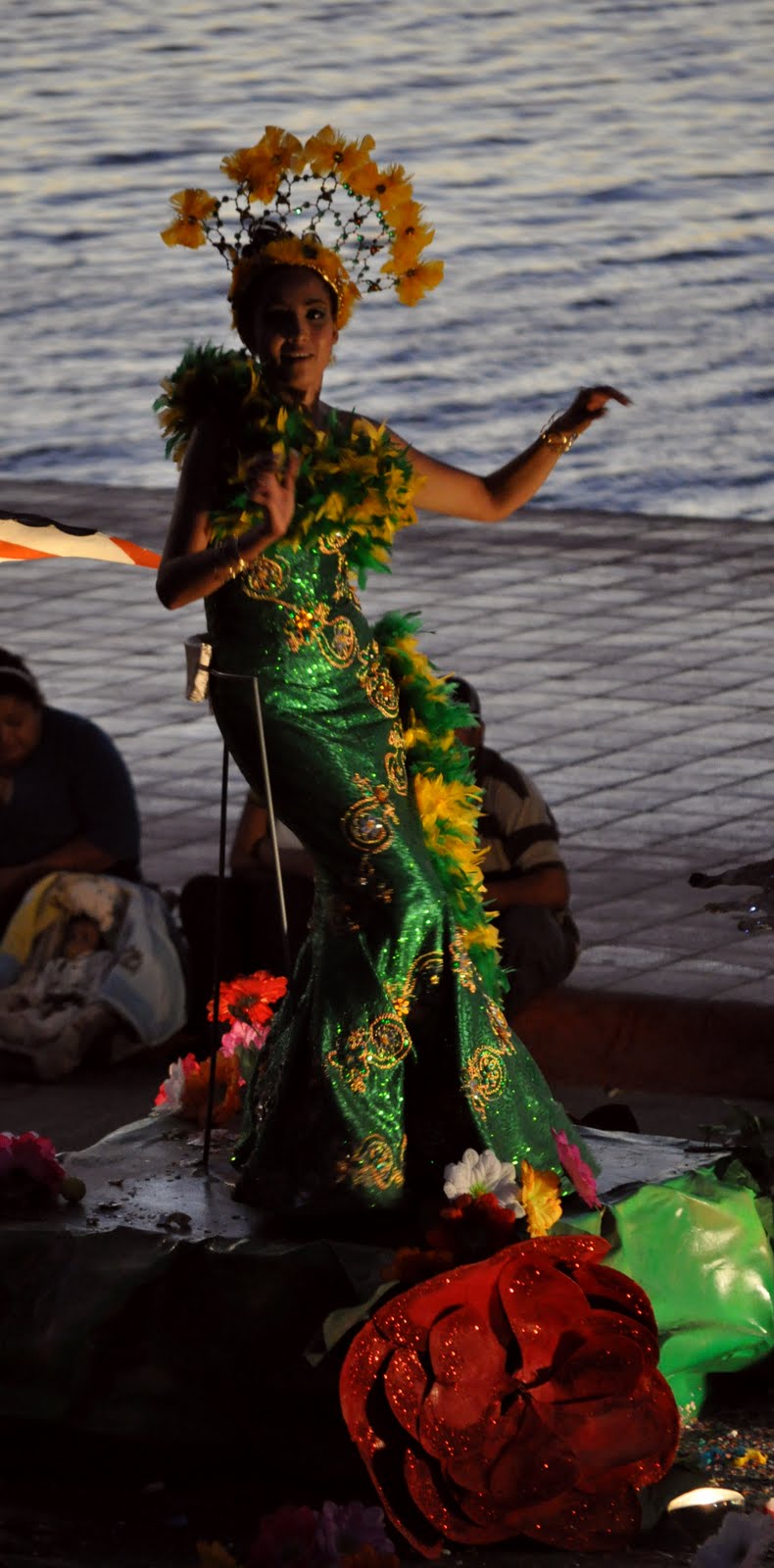
Carnaval!

Carnaval in La Paz runs through tonight. It started last Thursday. The Maleçon is pretty much shut down, and lined on both sides with booths selling food, beer, drinks, souvenirs and games.

For some reason, I really get a bang out of the balloon vendors. They look like they're carrying an impossible amount of stuff until you remember that what they're carrying is mostly, well, air. Still, I'm guessing that many mylar balloons has got to be pretty heavy.


Balloon Sellers

Most of the games involve shooting things or fishing them out of a pool of water.

There are also lots and lots of rides.

Things get going around 4:00 in the afternoon and get more and more raucous with music and dancing until the whole thing shuts down sometime well after 3:00. This has made getting any sleep an interesting proposition, as our marina is right downtown and it's been too hot to close the hatches at night. However, since someone either re-aimed or muted the freak show loudspeaker that was blasting "La niña más pequeña del mundo!" over and over at approximately 20,000 db on Thursday and Friday nights, it's not too bad.


(I have no idea why Mary Poppins is on this sign.
I'm also pretty sure "la niña mas pequeña" is
bigger than that. By quite a bit.)

The last three nights of Carnaval, there are parades. We went to the first one, on Sunday and watched from the street. That was fun, but the crowd was so dense it took us about an hour and a half to walk the mile back to our marina. And, in this mass of people all pressed together and moving different directions, we kept seeing women with strollers, usually trying to get from one side of the street to the other. It was wild. And I was a little afraid for the kids.

We went to last night's parade as well, but this time we had seats on the balcony at a restaurant above the action. Much better view, less claustrophobia, food and fun people. Much better. Unfortunately, set back a bit from the street, so it was hard to throw eggs at the parade. Not actual eggs - in La Paz (and who knows, perhaps in other parts of Mexico as well) they sell hollowed out eggs filled with confetti to throw.

Eggs

It's very festive. For some reason, the crowd was quite a bit thinner last night, so the walk home wasn't bad at all.

Some floats:


I believe these three ladies were the queen of Carnaval and her court:


There was a kids court as well:


Because where there are pelicans, there is guano, I like the realism on this one:


We were at the tail end of the parade route, so many of the participants, including, I suspect, this guy who got off of one of the floats and came up to see us in the restaurant, were pretty well lubed.

Friday, January 28, 2011

Caleta Partida


Art's son Todd is down visiting this week, so we wanted to take him out to the islands. We went to Caleta Partida, which we're been past a couple of times, but never visited. Nice spot. The coromuels cooperated (by not piping up) and we had two very pleasant nights there. Unfortunately, it's been uncharacteristically cloudy (it even rained a little yesterday afternoon and this morning), but it was warm, and the afternoons brightened up fairly reliably.


Before we left La Paz, we bought an outboard for our dinghy. We'd been trying to be purists and get by with just rowing our (hard) dinghy. That works fine when it's calm, but with any sort of wind or chop, it takes a really long time to get anywhere. We found a 2.5 HP Mercury at a shop here. Outboards are about twice as expensive here as they are in the states, but short of driving up there and bringing it back (hard to do, even if we had a car, which we don't) there's not really any good way to bring one down. So we paid up, and now have the world's tiniest four stroke outboard sitting on our stern rail. It works great, especially with the dinghy dogs on the Trinka. We aren't going to set any speed records, but it beats the heck out of rowing everywhere.

Todd and I each went for a paddle in the kayak - Caleta Partida has a passage at the back of it that leads between Isla Espiritu Santu and Isla Partida - it's too shallow except at high water to even get the dinghy through, but since the kayak draws about four inches, you can get pretty far back in it. We played around with the outboard on the dinghy (under the pretense of breaking it in), and did a lot of reading and lounging around. After the past two weeks, it was just what I needed.


They're not kidding when they talk about gin clear water. It felt like I was paddling around in a very large puddle of Bombay Sapphire. Except that wouldn't have smelled very good:

We have an inflatable kayak (the double/single one all the way at the bottom) with a frame and a backbone. It is one of my very favorite toys.


Sunrise in Caleta Partida:


On the way back to La Paz, we were boarded by the Mexican Navy. At least we think they were the Navy - they never actually identified themselves, but the uniforms and automatic weapons were sort of a dead giveaway. At first, we thought they were trying to sell us pictures of our boat (our Spanish, while a lot better, is still bad), as two of the guys had digital cameras and were snapping away like mad, but when we tried to tell them we already had a lot of pictures of our boat, it quickly became clear that that wasn't what they were interested in. They asked us all about our safety equipment, checked our paperwork (thankfully not dinging us for not having updated our crew list with Todd's name, which I think is technically required, but seemed like an awful lot of work for a three day trip), and then had Art complete some sort of customer satisfaction survey. He answered "¡muy bien!" to everything - with a guy holding an AK-47 about 5 feet away, really, what else was he going to check?

We're back in La Paz at Marina Palmira for a few more days. Next week, we'll move to Marina de La Paz, which finally has space for us. That's much more convenient to downtown, restaurants, etc. Marina Palmira is nice, but it's kind of out in the middle of nowhere, and you have to take a taxi or the three times a day shuttle to get anywhere. The bus, at 8 pesos, is much less expensive than a taxi, and more fun, too.

Todd goes home tomorrow. It was kind of a bummer that the weather was so cloudy and cool for the week of his visit - it was in the 70's and sunny all week in Menlo Park where he lives, but it sure was great to have him here.

NYE Dinner

Just came across this picture of our dinner on New Year's Eve at El Corazon.


That's David and Betsy from Mystic in front, Sarah and Darrell from El Tiburon behind Betsy, and Art and me behind David.

We're going there again tonight for Todd's last dinner on this trip to La Paz. Don't guess they'll have mariachis for just a regular Friday night, though...

Wednesday, January 26, 2011

Scott in Seattle

While I was in Seattle, I went out for dinner with our friends Scott and Eddie. Scott dug out his old Nehru jacket (circa 1968) for the occasion:


Saturday, January 22, 2011

Travel (expected and unexpected)

Our friend Scott came down for a 10 day visit on the 4th. We had all kinds of plans - going to the islands, maybe even back to San Evaristo. However, on the 7th, I got the sort of call that I imagine all of us with an elderly parent fear: my 94 year old father was not doing well. A blur of arrangement making ensued. I flew out of Cabo rather than La Paz, because I would get into RDU earlier that way. I had, I thought, thought of everything. Everything, that is, other than how I was going to get to the airport. We had a minor panic when we realized that all of the car rental places didn't open until 9:00 - 9:00 + 3 hour drive to Cabo + 1:00 flight wasn't going to work. Art finally found a rental place that was open, and we all (me, Scott and Art) set off for Cabo. It is a very pretty drive, although we did get stuck behind a very slow moving Corona truck during one of the mountainous sections that had me wondering if I was going to make my flight. Made the flight, got into Raleigh approximately 18 hours after leaving La Paz, collapsed.

I was able to be at my dad's bedside for a couple of days, although I don't think he really knew I was there. He died peacefully on the 11th. He had a good long time on this earth and an awful lot of people who loved him, which to me marks a life well lived.

I had a previously planned trip to Seattle for "business" (boat part acquisition and medical stuff) the week of the 16th, so I came straight here from NC. I fly back tomorrow at the ungodly hour of 6:00 AM. I can't wait to get home to La Paz and Arione. I am one tired camper.

Thursday, December 30, 2010

Ensenada el Cardonal & San Evaristo

A couple of weeks after we went to Todos Santos, Arione and El Tiburon took off for the islands. Isla Espiritu Santu and Isla Partida are a short hop from La Paz. Isla San Francisco and Isla San Jose are a bit farther. All are part of a national park. We had gone to Isla Espiritu Santu, where we spent one very pleasant night in Bahia San Gabriel - the second night we had coromuel (land) winds blowing so strongly into the anchorage that it was rougher in there than many of the passages we made getting down here from Seattle - right after we got to La Paz. It was beautiful, but although these winds are supposed to be a summer phenomenon, someone apparently neglected to inform the coromuels of this.

El Cardonel looked to be a bit better protected than San Gabriel, so off we went. It was quite windy the first night, but as the wind was coming out of the west and into the anchorage over a low part of the island, it didn't have the fetch (open water) required to build up any big chop. A mite uncomfortable, but the holding in there is pretty good, so we weren't too worried. We did, however, forgo rowing over to El Tiburon for drinks. We stayed for two days, Darrell and Art went rockfishing in the dinghy but didn't catch anything that looked particularly edible, and we got our drinks in on the second night. I somehow managed not to take any pictures.

Sparky (El Tiburon's dog) was getting pretty antsy because he couldn't go ashore, so we decided to head up to San Evaristo, a fishing village about 30 miles north of Isla Partida. It is extremely well protected, and as the winds were forecast to be high for the next few days, looked like a good choice. Boy, was it ever.

On the way up, I once again failed, despite using three different lures over the course of the trip, to catch a single fish. I am beginning to feel like a bit of a poor excuse for a fisherperson. After we got our hook set, the boat to starboard of us left, so we pulled up our anchor, moved over about a football field's worth and got set in about 12 feet of water - perfect spot. Of course, a couple of later arriving boats decided that if we were in there, it must be a good spot for them too. I don't know why that happens so often, even in large anchorages - it's a big bay, people. Let's use the whole thing. Our boat, like many, can sail around at anchor quite a bit if the wind comes up, so if there's room best to use it, really.

We went over to the beach and walked around a bit. There's not much there, a bunch of pangas, some shacks where the fishermen sell their fish to buyers who drive up from markets in La Paz, a few houses on the hill (most of the town is on the other side of the peninsula that divides this bay from the one to its north) a small store that sells beer (good thing, that - we were running low) and a sort of restaurant (more on that later). Sparky practiced his egret stalking skills, and played with a local black lab puppy. We saw lots of these guys - I think they clean up from the fish cleaning.


The second afternoon, we went over to the beach and bought a snapper (pargo perro). It was incredibly good. I however, in addition to being completely unable to catch fish, need to bone up on my fish anatomy. It had been gutted, but filleting a fish should not take a person 45 minutes.

Snapper with Pecans

1 T. butter
4 snapper fillets
2/3 c chopped pecans
1/2 tsp paprika
1/3 c butter
Juice of 1/2 lemon

Saute the filets in the tablespoon of butter until done (a couple of minutes). Remove to a plate and keep warm. Wipe out the pan. Melt the 1/3 c of butter and saute the pecans until fragrant and slightly brown. Add the paprika and lemon juice. Put the fish on serving plates, spoon over the pecan butter.


San Evaristo is home to thousands of pelicans. They dive into the water in large groups, making for a sort of staccato effect. I tried to capture a diving pelican on film, but couldn't, so you'll have to settle for a bunch of them floating around.

The last night we were in San Evaristo, Darrell found out that if you went over to the little cafe and told them you wanted dinner in advance, they'd cook for you. Well, yes, of course we wanted dinner.

Macho here was there to greet us when we arrived.


Fish, handmade tortillas, beans, fresh salsa, all delicious, were cooked for us by Lupita. We played a bit with the kids - Sarah had brought bubbles and a wand over for them, but we weren't able to communicate exactly how the bubble blowing process worked, so I suspect most of the bubbles wound up on the ground. The kids appeared to enjoy them anyhow - I know we did. As it got dark, we piled back into El Tib's dinghy and went back to our respective boats - we had a long trip back the next day, and were planning to leave early. What a lovely place.

The trip back was fairly uneventful, but in further fishing follies, a fish stole not only my last cedar plug, but my entire line. Yes, apparently, cleating the black nylon part of the handline isn't sufficient, although it had been all the way down the coast. Of course something that could pull a locked and cleated line off the boat was probably big enough that we really didn't want to deal with getting it aboard, so there's that. When I put out my other line, I tied a bowline in it. Did I catch anything? No, I did not. The fish are definitely winning - score stands at fish: 3 (2 cedar plugs, one handline) Jaye: 0. Fishing fail.
Todos Santos

The day after Thanksgiving, we and Sarah and Darrell of El Tiburon rented a car and went to Todos Santos, which is on the Pacific side of the Baja peninsula, about 50 miles south of La Paz. The roads were quite good, but definitely not freeways, plus we got lost trying to get out of town (Turn left at the Walmart? Which left? Then what? Does that gas station have a map? Of course not.) so the trip down took about an hour and a half. It's also, of course, really helpful to have three people who are not the driver having ideas and suggestions and really no idea where we needed to go. But make it out of town we did, eventually. It was a beautiful drive through the desert, which quite abruptly got very lush as we dropped into Todos Sants on the coast. There's a river that's only intermittently visible on the surface here, but its underground stream supports quite a lot of vegetation. We spent some time wandering around town.

Hotel California Lobby:

Entryway:


We went to the church on the main town square:


Had an excellent lunch, then drove out to the beach. The roads (tracks, really) were beyond sketchy, and we were sort of worried our poor little rental car was going to get stuck in the sand. Darrell, as it turns out, is excellent at driving in sand. There are lots of houses out here, but it's very isolated, and a rather large number of them appeared to be for sale.

The beach was gorgeous. It's very steep, so there's quite an undertow - no swimming - but pretty!


The colors that afternoon were just amazing. There's something about the light on the Pacific coast of Mexico that is unlike anywhere else I've ever been.

Art, Sarah, Darrell and Sparky went for a walk on the beach. I stayed up on the hill taking pictures.

Sparky's always a lot of fun to have around. He's just a really happy guy. Actually, here, he's a happy, wet and tired guy, but whatever.


It was a fun day for all of us -- and muchas gracias to Darrell, who did all of the driving!

Wednesday, December 29, 2010

La Paz

Our original plan was to spend through Christmas or so in La Paz, and then to head over to Mazatlan and Puerto Vallarta on the mainland. Planning, though, has never been our strong point, and we didn't anticipate how easy it would be to fall completely in love with La Paz. The mainland's not going anywhere. So at the moment, we think we're going to stay here until we head up into the Sea of Cortez in the spring.

We'd really like, at some point, to get into Marina de La Paz, which is a little funkier than the marina we are in now but right downtown. However, that's proving to be quite a difficult thing to do, and the folks and the facilities at Marina Palmira are so extremely nice, so we've just signed up for another month. We're only a couple of miles out of town, we have folding bicycles, and taxis are cheap.

Frailes

When we left San Jose del Cabo, our first stop was an anchorage called Frailes, a day or so to the east. Actually, we left SJdC twice, having realized the first time (luckily, we hadn't even gotten all of the way out of the marina) that we'd forgotten to turn in our dock keys. At $50 (US) a pop, we didn't want to hang on to those. I had, uncharacteristically, been wicked efficient with putting away the dock lines (won't do that again, will I?) so it was a bit of a fire drill getting tied up again. Got to Frailes, dropped the anchor, put on our suits and flung ourselves over the side into the 80 degree water. We'd been waiting a long time for that.

There were several boats that we know in the anchorage, and one of them, Corvidae, invited us all for drinks and appetizers. The appetizers were so abundant (not to mention really good) that we wound up not even bothering with dinner.

We'd hoped to stay for a few days, but when we listened to the weather in the morning, it appeared that a norther was building up. We really wanted to avoid being in the channel between Isla Cerralvo and the peninsula during a norther - it is fairly narrow and has a deservedly nasty reputation. So we pulled up our anchor at first light and headed for our next anchorage, Muertos.


Los Muertos (or Los Sueños, if you're in the tourism industry - "the dreams" is understandably more appealing than "the dead") was another lovely anchorage that we spent all too little time at. We got in late after a long day, and had another long day ahead of us, so we ate, crashed and again left at first light. We hope to revisit both of these places next fall before we head over to the mainland.

We have not, in fact


dropped off the face of the earth. We've been really enjoying La Paz and doing some local exploring - by water, by car and on foot. More soon.

Thursday, November 18, 2010

Fixed (hopefully)

So, the genset was not, in fact, getting its fuel through the return. What we had there was a labeling problem, which Art figured out by taking off the inspection port on one of the diesel tanks and feeling around for which fitting led to a pickup tube (that would be the supply). However, the hoses were indeed quite elderly, and when Devon started taking them off of the fittings yesterday, it was pretty apparent that air was getting into the lines. There were more than a few untightenable hose clamps - when the hose gets old and brittle, there's just no way to cinch it down around the fittings on the tanks, filters or engine. All of that's replaced now (which involved the yard in Cabo tracking down the last roll of 5/8" fuel line in Baja, because we needed about 20' more than they had in stock), and both engines are running like tops. We'll keep our fingers crossed, but it looks like the lines were the problem.

The plan for tomorrow is to get up early and hose off the boat (it's dusty here, and at $2/foot/night, damn straight we're hosing off the boat before we leave), and get up to Frailes, ~30 miles from here. We'll spend a couple of days there, then a couple of days at Muertos (Sueños, if you're the tourist authority) and then on to Marina Palmira in La Paz. Our friends Doug and Carla recommended Marina La Paz, but they were unfortunately full. Or full, unfortunately. Either way, no room for us right now. We'll try and get in there at some point - it's right in town, and we're expecting to be in La Paz for probably a month, so presumably someone will leave between now and then. We'll check with them in person next week.

I am so ready to be in an anchorage where we can just fling ourselves off the back of the boat to cool off.

Sunday, November 14, 2010

The Phone Company, and Some Local Flora

Yesterday, we went into town with our friends Sarah and Darrell to get Banda Ancha cards. These nifty little things are basically USB modems. For ~$30/ month, we have 3 gb of internet usage. We're going to go back and sign up for a six month contract, as apparently that doubles your usage limit. I don't think even I could use up 6gb in a month. Better yet, they sold us a little router that the USB modem plugs into. Our computers can connect to that over wifi, which means no need to share the internet connection. It's similar to a mifi. Telcel itself was painless to deal with. Verizon could come down here and take some lessons, I think. Instead of the phone company sending you a bill, you go to an agent (gas stations, tiendas, banks - they're all over the place) and put money into your account. Then to renew your service for another month, you just send a text message via the usb card, and, assuming you've got cash in there, you're all set. One of the nice things about doing it that way is that when we're in an area without cell coverage, we don't have to pay for service we can't use. Very cool.

Over the past couple of days, I've spent some time wandering around the grounds of the marina, taking pictures:

These little round cacti are all over the place. Off to the side, next to the road into town, they have about an acre of land just packed with them (apparently they're not done landscaping yet):


Before we came to Mexico, I'd never seen multi colored bougainvillea:


This afternoon, our friend Crit got a couple of hunks of tuna from some fishermen. We have nori and sushi rice aboard, so tonight we'll take those over to Jasdip and have tuna sushi for dinner. Mmmmm.